Legacy ERP Costs You More Than You Think | Enertia

Budget season is here. Before you pencil in another year of annual maintenance, it's worth asking what your legacy ERP is actually costing you.
Every July, the same ritual plays out in upstream finance departments across the Permian, the DJ, the Eagle Ford, and everywhere in between. Budget templates go out. Department heads defend line items. And somewhere on page four of the IT budget sits a familiar entry: annual maintenance and support for the ERP system you've been running since two commodity cycles ago.
It looks like the safe line item. It's known. It's predictable. Nobody gets fired for renewing it.
But "predictable" and "cheap" are not the same thing. For most upstream operators, the legacy ERP is one of the most expensive systems in the company...the costs just don't show up where anyone is looking.
The invoice is the smallest number
When CFOs compare the cost of keeping a legacy system against replacing it, the comparison usually starts and ends with the visible numbers: annual fees versus new license or subscription costs. On that math, staying put almost always wins.
The problem is that the invoice is a fraction of the real total cost of ownership. The rest is buried in your G&A, your headcount, and your close calendar.
Manual reconciliation is payroll, not software. When your land system, production accounting, AFE tracking, and general ledger don't share a database, your people become the integration layer. Every month, accountants export, re-key, and reconcile data between systems that were never designed to talk to each other. If three accountants each spend a week per month tying out data across disconnected systems, that's roughly nine person-months a year spent moving numbers from one screen to another. At fully loaded upstream accounting salaries, that alone can exceed what many operators pay in annual maintenance.
A slow close has a price tag. If your close takes twelve days instead of five, your leadership team spends nearly half of every month making decisions on last month's data. In a business where LOE per BOE, differentials, and well performance shift constantly, stale numbers mean slower interventions: deferred workover decisions, late catches on cost overruns, hedging conversations based on old lease operating statements. None of that appears on an invoice, but all of it hits the bottom line.
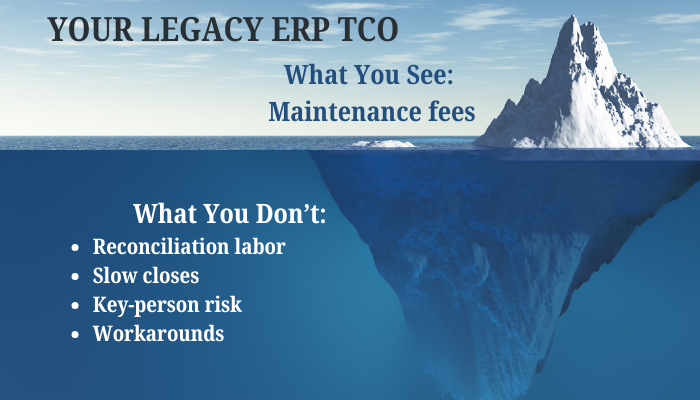
Key-person risk compounds every year. Legacy systems run on institutional knowledge. There's usually one person who knows why the revenue allocation works the way it does, one person who maintains the spreadsheet bridges, one person who can troubleshoot month-end when it breaks. Every year that person gets closer to retirement, and the pool of people who know the old system gets smaller and more expensive. You're not just paying maintenance on software; you're paying a scarcity premium on the people who can keep it alive.
Workarounds are technical debt with interest. The spreadsheet that reallocates JIB costs. The access database someone built in 2014 for division orders. The custom report nobody can modify because the developer left. Each workaround was a rational patch at the time. Together, they form a shadow system with no documentation, no audit trail, and no upgrade path...and your auditors are starting to notice.
The 2026 wrinkle: capex, opex, and the budget you're building right now
Budget season is also when the capex-versus-opex question comes up, and it's changed the ERP math considerably.
Legacy on-premise systems drag a long tail of capital costs behind them: server refreshes, database licensing, disaster recovery infrastructure, and the periodic "forklift upgrade" that consumes a quarter of consulting fees. Those are lumpy, hard-to-forecast capital events competing directly with drilling and completion dollars for a slot in your capex budget.
A modern, cloud-deployed upstream ERP moves that spend to a predictable operating expense, a known monthly number that scales with your business instead of spiking when a server rack ages out. For operators managing capital discipline in a volatile price environment, converting IT surprises into a flat opex line isn't an accounting nicety. It's one less thing competing with your drilling program.
That's exactly the conversation to have now, while the 2027 budget is still soft. A replacement decision made in Q3 can be budgeted properly, scoped realistically, and timed to go live between year-end close and the spring audit, instead of being an emergency purchase made after the legacy system finally breaks something expensive.

How to make the ROI case in numbers your CFO will accept
If you want the modernization conversation to survive contact with a skeptical finance team, quantify four things:
Labor hours in the reconciliation layer. Ask your accounting, land, and production teams to estimate hours per month spent on manual data transfer, re-keying, and tie-outs between systems. Multiply by fully loaded cost. This number is usually the largest and the most defensible.
Days to close, priced. Estimate the value of a faster close in terms of decision speed: earlier visibility into LOE trends, faster JIB and revenue processing, quicker responses to partners and auditors. Even conservative assumptions here add up.
True legacy carrying cost. Add annual maintenance, infrastructure, third-party bolt-ons, custom report maintenance, consultant hours, and the audit hours spent explaining spreadsheet controls. Most operators have never totaled this list. Most are surprised when they do.
Growth friction. What does it cost to onboard an acquisition onto your current system? If integrating acquired properties takes six months of manual mapping and cleanup, that delay has a dollar value. And in a consolidating upstream market, it may be the biggest number of all.
Put those four figures next to the cost of a modern, integrated upstream ERP and the comparison changes shape. The question stops being "can we afford to replace it?" and becomes "how much longer can we afford not to?"
Built for upstream, priced for reality
This is the problem Enertia was built to solve. One integrated platform for land, production, accounting, and operations: one database, one version of the truth, no reconciliation layer made of people and spreadsheets. Your accountants close faster, your engineers see costs sooner, and your CFO gets a TCO story that actually holds up in a budget meeting.
Budget season only comes once a year. Before you renew the "safe" line item, run the real numbers.
Ready to see what your legacy ERP is really costing you? Talk to the Enertia team about a TCO assessment before your 2027 budget locks.