Modernize Your ERP Without Disrupting Year-End Close

Every oil and gas finance leader knows the feeling. Q3 close just wrapped, the friction points are still fresh, and somewhere in the back of your mind is the knowledge that year-end is coming fast. It's the worst possible time to be running a new system implementation, and yet it's exactly when the case for modernizing your ERP feels most urgent.
That tension is why so many operators put off the decision. The fear isn't whether a modern ERP would help. It's whether the transition will blow up the most sensitive reporting window of the year. Nobody wants to explain to leadership why the close slipped because IT was mid-migration.
The good news: modernizing your ERP and protecting your year-end close are not mutually exclusive. With the right approach and the right timing, you can do both.
Why Q4 Is Actually the Right Time to Plan
There's a reason most companies target Q1 go-lives, and it's not coincidence. The window between the end of Q3 close and the start of year-end is when your team has the clearest view of what's broken. The manual reconciliations, the spreadsheet workarounds, the reports that take three people and two days to produce. Those pain points are top of mind right now, not buried under the next fiscal quarter's demands.
Planning now means you're specifying requirements against real, recent frustration rather than vague memory. It also means you're positioned to go live in Q1, when a clean fiscal year gives you a natural cutover point and the least amount of legacy data to carry forward.
The mistake operators make isn't planning in Q4. It's assuming that planning in Q4 means implementing during year-end close. Those are different things.

The Real Source of Implementation Risk
When operators say they're afraid of implementation risk, what they usually mean is one of a few specific things: a go-live that drags on for months, a data migration that corrupts historical records, or a cutover that leaves the team locked out of critical systems during a reporting deadline.
Each of those risks traces back to the same root cause: an implementation timeline that's too long and too rigid to work around your operational calendar. When a rollout stretches across two or three quarters, it inevitably collides with a close, an audit, or a reporting deadline. The longer the implementation, the more likely it is to interrupt something that matters.
Shorten the implementation, and you shrink the collision zone.
Quick Turnaround as a Risk Reducer
This is where Enertia's implementation approach changes the calculation. A faster, more disciplined implementation isn't just a convenience. It's the single most effective way to keep modernization from interrupting your close.
A quick turnaround means the migration and configuration work can be scheduled cleanly around your fiscal calendar, not draped across it. It means your team isn't living in two systems for months while the deadline for year-end reporting bears down. And it means you can realistically plan a Q4 kickoff for a Q1 go-live, with the new system fully operational before the next reporting cycle begins, and all without touching the year-end close you're closing out right now.
Purpose-built for oil and gas, Enertia handles the industry's specific accounting, land, and production requirements out of the box, which removes much of the custom configuration work that stretches generic ERP implementations into multi-quarter ordeals.

What This Looks Like in Practice
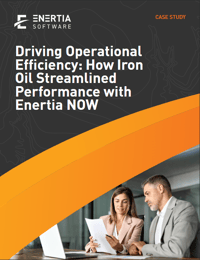
The strongest proof that a modern ERP delivers isn't a promise. It's a track record. Iron Oil, an upstream operator in the Williston Basin, partnered with Enertia to move onto Enertia NOW, a cloud-based, out-of-the-box ERP, and streamlined and scaled its operations in the process.
Because the solution is purpose-built and delivered out of the box, Iron Oil gained real-time access to production and financial data, automated workflows that cut manual data entry, and a subscription-based model that let the company scale without costly IT overhauls. It's a concrete example of the destination this kind of modernization is meant to reach: a leaner, more scalable operation running on a system built for oil and gas rather than bent to fit it.
Start the Conversation Now, Not in January
If your Q3 close surfaced problems you don't want to repeat at year-end, the time to act is now, while those problems are still fresh, and while there's still runway to plan a clean Q1 go-live. Waiting until January means starting the requirements conversation cold, after the pain has faded and the momentum is gone.
Modernizing your ERP doesn't have to mean risking your close. It just means choosing an implementation approach built to work around your calendar instead of against it.
Frequently Asked Questions
Can I modernize my ERP without disrupting year-end close?
Yes. The key is a quick-turnaround implementation that can be scheduled around your fiscal calendar rather than draped across it. A Q4 kickoff aimed at a Q1 go-live lets you modernize without ever touching the close you're finishing now.
When is the best time to plan an ERP implementation for oil and gas?
Right after Q3 close is ideal. Your team's pain points are fresh, you can specify requirements against recent frustration, and you're positioned for a Q1 go-live, when a clean fiscal year offers a natural cutover point with the least legacy data to carry forward.
Why do ERP implementations feel so risky during close?
The risk usually traces back to timelines that are too long and too rigid. When a rollout stretches across multiple quarters, it inevitably collides with a close, an audit, or a reporting deadline. Shortening the implementation shrinks that collision zone.
How does Enertia keep implementations fast?
Enertia is purpose-built for oil and gas, so it handles the industry's specific accounting, land, and production requirements out of the box. That removes much of the custom configuration work that stretches generic ERP implementations into multi-quarter ordeals.
Should I wait until after year-end to start?
Waiting means starting the requirements conversation cold, after the pain has faded and the momentum is gone. Planning now, while Q3 friction is still fresh, keeps runway open for a clean Q1 go-live. The Iron Oil case study shows what a modern, oil & gas-built ERP delivers once it's in place: streamlined, scalable operations.
See how it's done. Download the Iron Oil case study to see a real-world example of an operator that streamlined and scaled with Enertia.